
Okay, I have found another study method, and that is, when a lot of reading is assigned, to break the reading material into chunks over several days, even when discussion board responses are due.
An example would be: I read half of what is assigned, I cover enough to answer the question that is due today, even if I feel like I am missing something. As long as it contributes to the discussion board, that is good enough.
The discussion boards alone are worth 3/3, which isn’t huge initially, but overall, they add up. Still, the cumulative effect isn’t drastic enough to strive for perfection here.
Tomorrow, I can read the rest of the assigned reading, even if I don’t have all the answers or material consumed.
This works for me because, before this, I was reading everything in one day and then trying to answer the questions. While it would work for the most part, I found that on test day, I had forgotten a percentage of the information, leaving me somewhat confused even after reviewing once more.
I am learning that when my brain gets groggy and my eyes start to drift, it is time to switch to the next subject.
Connections have been made but they need time to soak into the grooves of my brain for long-term storage.
Here is more about why this study method should work moving forward.
I began this article a week ago, not knowing I would be wrapping up a study plan on memory this week for my psychology class.
In 1885, German psychologist Hermann Ebbinghaus analyzed the process of memorization. He became known for the forgetting curve.
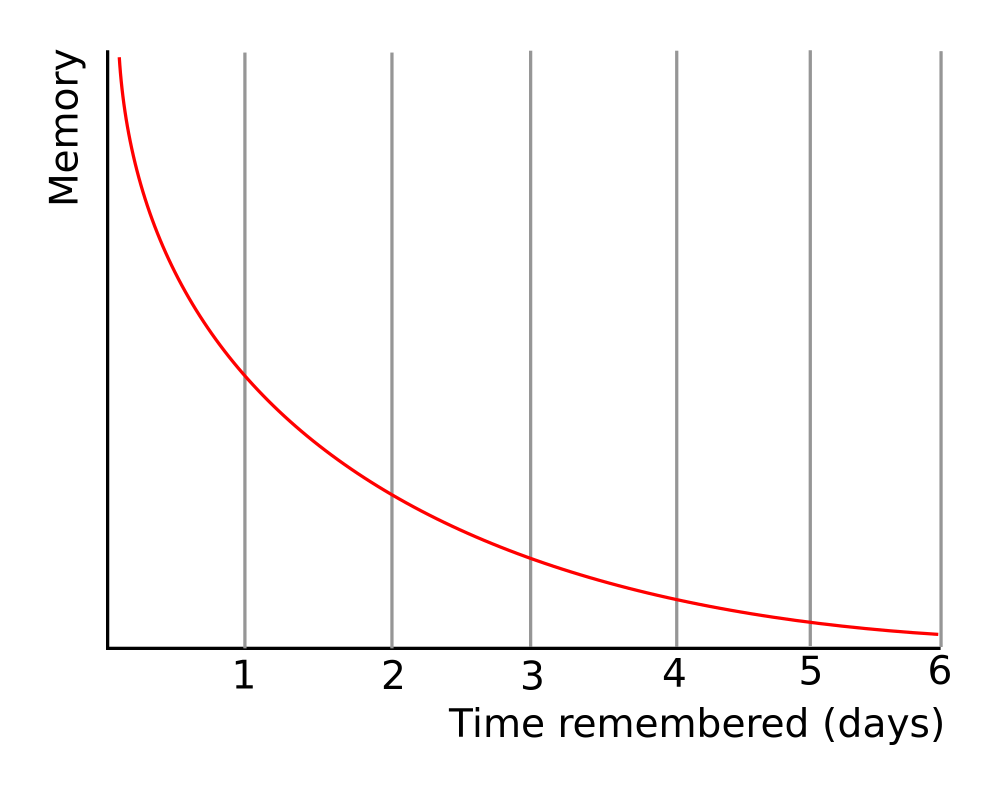
Ebbinghaus found that information drops off rapidly immediately after learning but levels off at about 20% after 30 days. He also studied and suggested the value of practicing at spaced intervals over time to promote retention.
This makes sense, given what I have come to notice about my own levels of retention and realizing that chunking would be more efficient moving forward.
I have already put the plan in motion, and it’s too early to tell since today was only the second day of applying it. Yesterday (Sunday), I read the main text for my philosophy class.
Today, I read the external links, and tomorrow, I will watch the external videos linked. Then, tomorrow night or Wednesday, I plan on participating in the discussion board and taking the quiz.
I get the feeling that with this kind of class, where the teacher assigns reading after reading, it will work best, especially given the dense language used in philosophy, which might be challenging for anyone not deeply interested or encountering it for the first time.
Spaced intervals will allow me to retrieve information easier since it will be revisited more often, rather than one-day consumption, even if the material can be consumed within a 24-hour time frame, it is better to revisit it multiple times.
(Revisiting can look like reviewing the previous material and/or just revisiting the subject itself so it can stay fresh in your mind).
Of course, this works only if I am reasonable with time and factor in turnaround times for due assignments.
For example, due dates for assignments in philosophy are getting closer together, so now there’s a four-day turnaround instead of a week.
In the beginning, it was Monday for discussion, Wednesday/Thursday for discussion, and Sunday for the quiz. Now, the first discussion is due on Sunday, for example, and the quiz is due Wednesday, the same day as the second discussion.
Chunking my reading assignments will continue to look like this: the main text on the first day of the discussion due date, the next day for external reading assignments.
The third day for linked YouTube videos, the fourth day for the discussion board, and quiz.
I also applied this while practicing for my midterm exam for statistics. I have 36 practice questions for the exam before taking it on Thursday (May 2nd). I did 12 tonight, so I could take detailed notes.
Tomorrow, I will do another 12, with detailed notes, and on Wednesday, the last 12 with detailed notes.
Then on Thursday, I will review it all, but since it’s an open book exam, I am confident that the detailed notes I’ll be taking will allow me to get through the exam.
Sometimes getting ahead and getting work done fast is beneficial, but in the case where material needs to be constantly revisited for long-term retention, it is good to space yourself out so you don’t forget when test time comes
Below, you can read more about the forgetting curve. Most of what I learned about it was from my psychology class, and I can’t link to the material, so here is the next best source I could find to explain it more.
I hope it helps!
Update 5/23/24 I ended up with a 98% on my statistics midterm!
 The Broke College Student
Leave a comment