
I was listening to music from a well-known beloved pop artist on the bus ride home from school and began thinking about another known artist that had recently passed away after years of drug use and mental health. This artist once claimed that the current beloved artist I was listening to owes him homage for paving the way.
If you can put two together you’ll be able to figure out which artist inspired this blog post. Thinking about these two artists got me thinking about trauma and the tortured soul if you will and that no matter what we see externally around us and others it is the internal state that matters the most.
The body holds trauma and until we address it we often deal with aches and pains and illnesses that accompany the trauma we hold onto.
Trauma isn’t always the cause of these things, but I am inclined to believe they can contribute to these things more than not.
People can work out and get into fitness but they can’t beat the aging of their internal turmoil, it’s why we can have everything around us, that looks great on the outside or in this case be super in shape but always sick or irritable.
Securing external wants such as houses, cars, and loaded bank accounts, can contribute to well-being but nothing of external magnitude can beat the internal clock of our ailments and overall health when we ignore them.
Symptoms that are left over residue from heartbreak, loneliness, or any sort of trauma, can run circles around the external factors of success we secure for ourselves.
This is why it is important to understand that most external factors are the byproducts of two tools, money, and success, nothing else.
Abrahams Maslow, an American psychologist, is known for his role in humanistic psychology and the well-known theory in the psychology field known as Maslow’s hierarchy of needs.
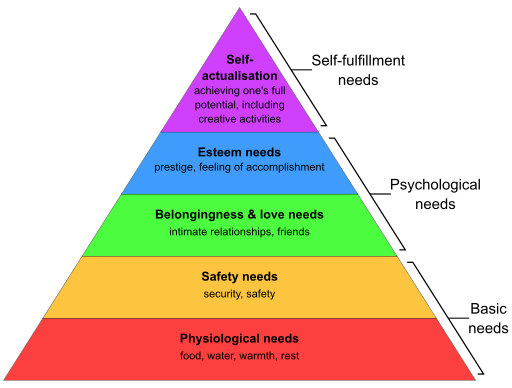
Maslow’s hierarchy of needs is a psychological theory that arranges human needs into a hierarchical structure, with basic physiological needs at the bottom and higher-order needs like self-actualization at the top. It suggests that individuals must satisfy lower-level needs before progressing to higher-level ones.
Here is a visual image for understanding.
What happens is that sometimes we forget that even though some or all of these needs are met we can still find disruption. Some studies have shown that there is no impact between the order in which these are met and the satisfaction of people’s lives.
In their review of the available research, Wahba and Bridwell found that there was little empirical support suggesting that needs exist in a hierarchy at all
Wahba MA, Bridwell LG. Maslow reconsidered: A review of research on the need hierarchy theory. Organizational Behavior and Human Performance. 1976;15(2):212-240. doi:10.1016/0030-5073(76)90038-6
With that said my sole interest isn’t so much in the order of Marlow’s Hierarchy of Needs, but how much of the implementation of these steps rise and fall upon our psychological and internal world.
We now know that external success alone is not sufficient to alleviate or eliminate trauma, especially when the trauma is not addressed or acknowledged
So now to answer our question of how external success fails to eliminate internal trauma, we see that safety is part of Maslow’s theory, and even though some studies have shown that there is no strong empirical evidence about the hierarchy it was still found that his idea was useful- even with the noted flaws.
You can read more about the problems with his concept here.
If we focus on the second step of the pyramid we find that it is titled safety needs, let’s amuse his theory and the hierarchy of it all. You can see that external factors are towards the top of the pyramid, meaning that someone who doesn’t meet their safety needs might find disruption in their life while moving up the pyramid.
Part of meeting our safety needs is addressing elements such as the need for financial security, stability, law and order, social stability and protection from physical and emotional harm, however, here I am going to include my own take and that is trauma and events we have experienced.
For our safety of needs to be met we must allow our bodies and minds to process and release built-up tension from trauma and the experiences involved which more times than not consumes our thoughts and behavior towards ourselves and others.
This is where we can often find ourselves or those we admire in conflict within, knowing we shouldn’t do x, y and z but we do it anyway, or we see someone that seems to have it all but can’t get their ‘act’ together.
- we know we shouldn’t lose our temper but we do it anyways
- we know that substance use isn’t a great coping mechanism but we do it anyways
Emotions and substance use in this context have two things in common and that is that both often cover the underlying issues we are facing, and both often lead to disturbances in our lives even when other steps of Marlow’s hierarchy are met.
Understanding that external factors cannot always eliminate trauma allows us to have a better understanding of the complexities that humans face and lead with compassion towards those who seem to have it greener.
And towards ourselves when we are in search of becoming better versions of ourselves.
I hope this post was insightful and useful.
P.s I had started writing this sometime around late April or the beginning of May, either way I am just now finishing it up after classes have ended and I have just a week before school starts back up.
 The Broke College Student
Leave a comment