
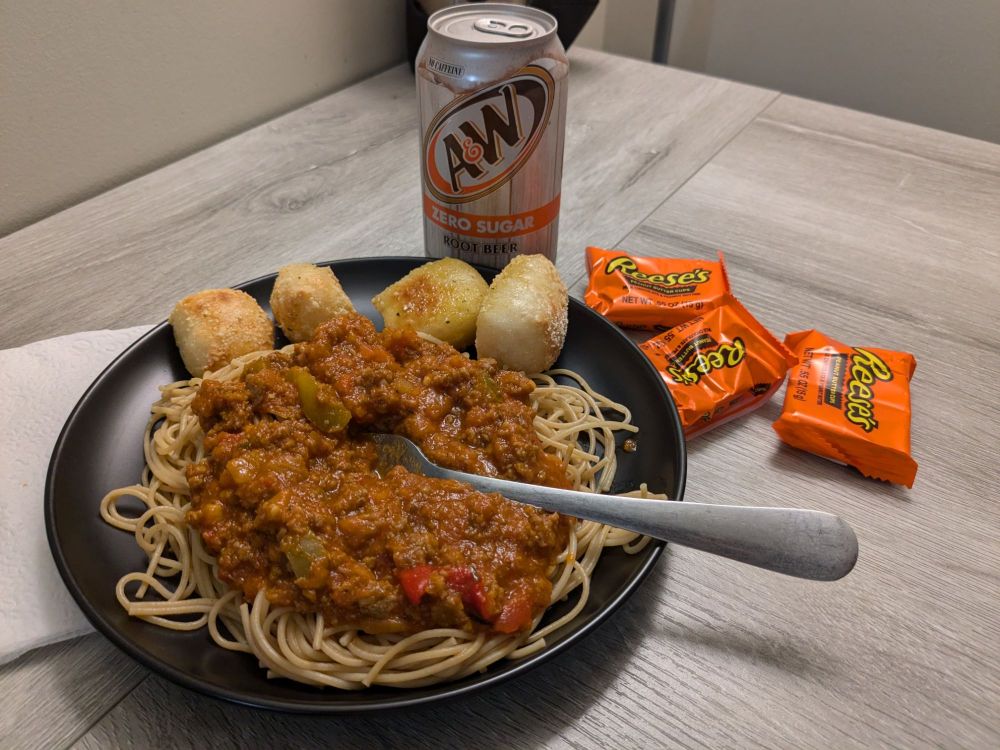
Tonight, I am eating whole wheat thin spaghetti that cost me $1.99. It’s made with seasonings that I purchased several months ago, a jar of Ragu chunky garden pasta for $1.99, Italian ground turkey $3.99 and a bag of frozen pepper strips and onions.
For dessert, I have Reese’s cups, which cost $1.79 for a 5-pack, and a can of zero sugar A&W root beer. The case was on sale a week ago for $6, so the can is $0.50. I also have free Domino’s Parmesan bread bites that I got with a coupon.
I’ll embed the recipe for spaghetti below, where I discuss how frugal this meal can be for college students or low-income earners looking to save money on meals.
Notice how I broke down the prices for the soda into a per-can cost. This is a great way to determine if a deal is worth it or not. Just because something is on sale doesn’t mean it’s a steal, and just because something isn’t on sale doesn’t mean it’s not worth purchasing.
Breaking down Affordable Meals by Cost and Price per Unit
When shopping for items you use often, you want to make sure you’re looking at the price per unit. This is why some people buy in bulk. Rather than buying a prepackaged bag of rice, they might buy rice in bulk because it’s often cheaper when broken down by unit compared to prepackaged items.
It’s important to understand the cost per unit and whether it’s something you’re willing to split with. For example, at my local Safeway, a case of soda normally costs $9.99, which is a lot. However, when it’s on sale for $2.99, $4.99, or even $6, I’m more willing to consider it because the cost per can is lower—$0.50 or less. To me, this is a great deal because I’m not willing to pay a dollar per can.
For instance, I enjoy Zevia, one of my favorite sodas, but the cost per can is too high for my budget. Although it’s a great alternative to diet soda with aspartame because it’s made with stevia and is more natural, I can’t justify the expense right now given my other financial goals.
Let’s break this down mathematically to make it easier to understand.
Example 1: Rice
Buying in Bulk
- A 20-pound bag of rice costs $15.99.
- Price per pound: $15.99 / 20 = $0.80 per pound.
Prepackaged
- A 2-pound bag of rice costs $2.99.
- Price per pound: $2.99 / 2 = $1.50 per pound.
Comparison:
- Buying in bulk at $0.80 per pound is significantly cheaper than the prepackaged option at $1.50 per pound. This means you save $0.70 per pound by buying in bulk.
Example 2: Cereal
Buying in Bulk
- A 40-ounce box of cereal costs $7.99.
- Price per ounce: $7.99 / 40 = $0.20 per ounce.
Prepackaged
- An 11-ounce box of cereal costs $3.49.
- Price per ounce: $3.49 / 11 = $0.32 per ounce.
Comparison:
- Buying in bulk at $0.20 per ounce is cheaper than the prepackaged option at $0.32 per ounce. This means you save $0.12 per ounce by buying in bulk.
This is an example of buying in bulk., however, you might not even need to spend that much dependent on your personal situation.
For a single college student or a household with just two people, buying in bulk might not always make sense unless you know it’s something you’ll use often, like rice.
For my household, we go through a lot of rice, so buying it in bulk for two people might make sense at $15.99, ensuring I don’t have to buy it again for the rest of the year. This is more economical than buying rice at $2.99 $3.99 every 2-3 of weeks.
The great thing about bulk buying is that you don’t have to buy it pre-packaged. You can go to places like WinCo, a local grocery store in my area, where they have containers of dry food items.
You grab a bag and weigh it by the pound. I used the mathematical example above to show what a price per unit or price per pound looks like, making it easier to understand the value of bulk buying.
However, just keep in mind that buying in bulk doesn’t always mean it’s a great deal for you. As previously mentioned, it depends on your personal situation.
If you’re a single person, a college student, or someone who doesn’t use an item often, bulk buying might not make sense. Sometimes, pre-packaged options can be cheaper because they are frequently on sale or priced just right for your needs. You might not need to buy in bulk.
It really depends on your personal circumstances. It’s good to have these options at your fingertips to understand when buying in bulk is right for you and when it might not be.
Think of it like having a wrench, a hammer, and a screwdriver. You may not need the wrench or the screwdriver when you’re trying to hammer a nail, but it’s good to have them. When you do need to screw something in or tighten something, you have the right tools.
It’s Only a Deal if It Fits Within Your Budget and or Is Something Frequently Consumed
A lot of people grew up with the wrong misconception of money and what it means for something to be on sale. It wasn’t until a family member of mine said something that stuck with me since my early twenties.
We were at our local grocery store one day, and there was something on sale. I said, “This is a great deal.” We were standing in the cold drink aisle where jugs of tea, fruit juices and other beverages lined up.
I remember casually asking the person, “That’s a great deal, should I get it?” They replied, “Did you plan on spending that? ” I said, “No, but that’s a great deal.” They responded, “It’s only a great deal if it’s what you planned on spending in the first place.”
This has stuck with me ever since because, even though it was an item I sometimes consumed, it wasn’t something I needed or always had. Even if there’s something on sale, it doesn’t mean it’s a great deal.
Furthermore, if you have a budget of $100 and that so called great deal takes you out of your budget by $10 or even $5, it’s more about the cost in the long run, which is building a habit that is detrimental in the long run.
It influences the mindset that every time you see something on sale, you should spend money on it because it’s on sale – don’t fall into this trap.
It’s really easy to fall into it, especially with groceries. We tend to justify our actions and rationalize them when it comes to basic needs like food, because it’s something we don’t often feel guilty about spending money on.
However, there is a way to manage even basic needs like food if you’re trying to save money and be frugal. It’s okay to miss out on some sales, unless it’s something you normally consume. For example, if you eat chips every day with your lunch, then a deal on chips is great.
But if you don’t usually drink soda or sparkling water, don’t buy it just because it’s on sale. I see a lot of people doing this. Sure, if you want to try a case or two, go for it, but make sure it doesn’t become a habit just because it’s on sale.
Remember that certain things can be treats or part of your budget, but the more you add to your budget, the more you’re taking away from your future self or your savings. Don’t let deals confuse your mission or your purpose of trying to save money and stick to a budget.
For those who don’t have much money or who are sticking to a budget because we have no choice, this usually doesn’t become a problem because we there is no extra money to spend on things even if they’re on sale.
But those who have a little bit more money to spend but are low income and still need to be cautious about their budget, this is something they should watch out for.
 The Broke College Student
Leave a comment