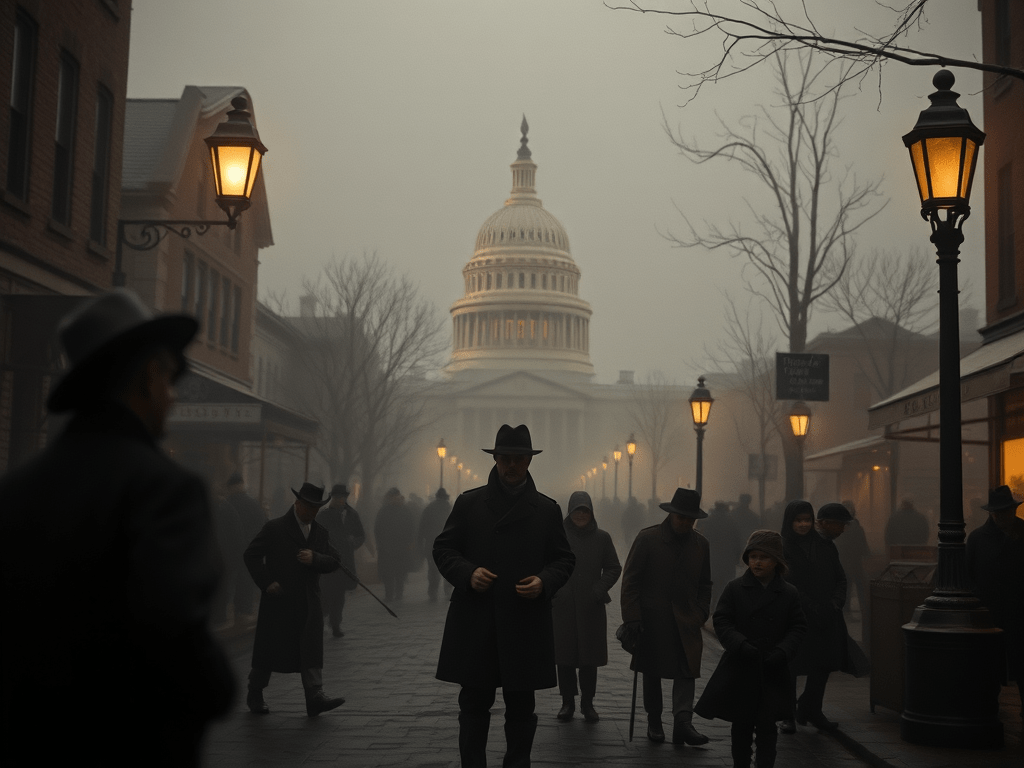
Ah, gather ’round, dear reader, and lend your ear to a tale of trade, turmoil, and the ghostly grip of economic folly past, a tale as richly woven and instructive as any penned by Master Dickens himself. Let us walk the foggy streets of early 20th-century America, where ambition and fear danced hand-in-hand, and the spirit of commerce was both hero and villain.
The Tale of the Smoot-Hawley Tariff: A Cautionary Chronicle of Economic Woe
Chapter the First: In Which Fear Begets Folly
It was the spring of 1930, and America, still reeling from the collapse of the stock market in the fateful autumn of ’29, stood at a precipice. The streets, once bustling with the cheer of roaring twenties prosperity, now echoed with the hesitant shuffle of bootless men and the hollow laughter of children whose bellies knew too little bread.
In the hallowed halls of Congress, two well-meaning gentlemen, one Representative Willis C. Hawley of Oregon, and the other Senator Reed Smoot of Utah, sat by flickering lamplight, pondering how best to protect the American farmer and worker. The land was aching; prices of agricultural goods had plummeted, and factories hummed with less vigor.
Thus was born the Tariff Act of 1930, a parchment of good intentions wrapped in the ribbons of economic nationalism. It came to be known, rather infamously, as the Smoot-Hawley Tariff.
“Let us raise duties on imported goods,” they said, “to shield our laborers from the cruel winds of foreign competition!”
Yet, as with so many tales of earnest but misguided attempts to heal a bleeding wound, the cure did not soothe, it stung, and bitterly.
Chapter the Second: Of Spiraling Duties and Shuttered Doors
With pen to paper and signature from President Herbert Hoover, who, under great pressure, relented despite his misgivings, the Smoot-Hawley Tariff became law in June of 1930. It raised tariffs on over 20,000 imported goods to record levels.
Imagine it, dear reader: a farmer in Iowa, hoping that by taxing foreign wheat, his own crop would fetch a fairer price; a machinist in Detroit, praying that taxes on imported steel would save his job. And yet, like so many cobbled London streets slick with rain and regret, the world turned dark.
For you see, trade is no monologue, but a dialogue, a dance of give and take. And when America raised her walls, so too did other nations. Canada, France, Britain, and Germany responded with retaliatory tariffs. Ships once heavy with goods now sat listless in harbors, their sails limp, their cargo unsold.
Exports from the United States plummeted by more than 60%. Global trade contracted by over two-thirds. Companies closed. Unemployment soared. The world, once linked by hopeful markets, drifted into an era of cold suspicion.
Chapter the Third: The Ghosts of Economies Present
Historians and economists, robed in their tweeds and armed with hindsight, often gather to recount this tale not as ancient lore, but as warning.
For in the world of global economics, the Smoot-Hawley Tariff stands as a grim specter, a symbol of how protectionism, when taken to an extreme, can turn a recession into a depression.
Yes, other factors contributed to the Great Depression’s depths, the failures of banks, the tightening of credit, and the absence of a safety net for the destitute, but few deny that Smoot and Hawley’s legacy deepened the gloom. International cooperation fractured. Extremism found root in the bitterness of want. The seeds of global conflict found fertile soil in economic despair.
Chapter the Fourth: Of Keywords, Commerce, and Common Sense
Ah, gentle reader, in our modern parlance, let us frame this tale in the tongue of the search engine and the algorithm, that it may find its way to many a wandering browser.
- What was the Smoot-Hawley Tariff Act? It was a 1930 law that raised U.S. tariffs on over 20,000 imported goods, with the aim of protecting domestic industries.
- Why did the Smoot-Hawley Tariff fail? Because it triggered international retaliation, shrinking global trade and worsening the Great Depression.
- What are the consequences of protectionism in a global economy? While short-term gains might be seen for select industries, long-term effects often include trade wars, economic isolation, and reduced growth.
- What lessons can we learn from the Smoot-Hawley Tariff? That no nation is an island in the sea of commerce; cooperation often yields more fruit than confrontation.
Chapter the Fifth: A Future Unwritten, A Warning Unheeded?
And now, let us speak plainly, with hearts open and eyes forward. For the past, though inked, is not merely a tale to be told—but a guide to be followed, or a mistake to be repeated.
We live again in times of uncertainty. Murmurs of nationalism echo through chambers of power. There are those who cry, “Build walls! Raise tariffs! Let us look inward!” They, like Smoot and Hawley, may mean well. But meaning is not enough when the consequences are grave.
In a world more connected than ever, through silicon chips and fiber cables, through airplanes and multinational treaties, the lesson of Smoot-Hawley is clear:
Beware the seductive call of economic isolation. For in turning away from others, we may find ourselves turned away from prosperity itself.
Epilogue: In Which Hope, Perhaps, Endures
And yet, all is not gloom. From the ashes of depression rose institutions built on unity: the World Trade Organization, the International Monetary Fund, trade pacts forged in the spirit of peace and shared prosperity.
Let us not forget: even after Dickens’ darkest chapters, the sun breaks through. The miser learns kindness. The orphan finds home. And the world, if wise, can learn from its errors.
So should you find yourself in a place of influence, be it a boardroom, a ballot box, or a classroom, remember this story of Smoot and Hawley. Let it guide your thoughts, shape your arguments, and temper your instincts.
For history, when ignored, has a nasty habit of repeating itself.
In Summary, for the Inquisitive Searcher:
- The Smoot-Hawley Tariff Act of 1930 was an attempt to protect U.S. jobs by raising tariffs on imported goods.
- Its unintended consequence was a collapse in global trade, worsening the Great Depression.
- It remains a historic warning against protectionism and trade isolation.
- In today’s globalized economy, such measures can backfire spectacularly, harming the very people they aim to help.
- Learning from history is vital to building a resilient and cooperative future.
And thus ends our tale, not in despair, but in vigilance. May we heed the lessons of the past, not only to avoid its errors but to craft a future where prosperity is shared and sustained.
Final Word: For the Student of Tariffs, Still Eager for Truth
Should this tale of the Smoot-Hawley Tariff have stirred your mind like a wintry breeze through a candlelit study, fear not, the story of tariffs themselves is yet broader still. This was but one chapter in a grander tome.
If you wish to understand the why, the what, and the how of tariffs, those invisible tolls that shape the fate of nations, then you mustn’t stop here. Wander, if you will, into our companion piece: Tariffs 101 – Why They Exist, What They Do, and How They Shape Economies.
There, you shall find not ghost stories, but clear explanations. Not lamplight and parchment, but charts, reasons, and reflections on why these duties exist at all, and how they can both build and break.
Until then, dear reader, may your curiosity stay warm and your wisdom ever grow. 🕯️📚
—The End (or just the beginning)
 The Broke College Student
Leave a comment