I started my investment fund with $150.
Not $1,500. Not $15,000. One hundred and fifty dollars. And before that, there were months where I had more month than money, where I was eating bread with beans and butter and wondering if any of this was ever going to change.
So when most wealth calculators assumed I was starting from a clean slate, from zero or better, they weren’t built for me. They weren’t built for the person sitting in a one-bedroom apartment in Tacoma trying to figure out if $20 a month even does anything.
That’s why I built this one differently.
→ Use the Broke to Building Wealth Calculator
Why Most Wealth Building Calculators Miss the Point
The standard wealth calculator gives you a starting balance, a return rate, and a number at the end. Clean and simple. But it assumes a starting point that a lot of us don’t have.
It doesn’t account for debt. It doesn’t acknowledge that for some of us, month one looks like -$3,000 or -$8,000 or worse. And it definitely doesn’t tell you what your first $1,000 milestone actually means, which, if you’ve never had $1,000 to your name, is everything.
Charlie Munger used to say the first $100,000 is a bitch. I’d argue the first $1,000 is its own version of that, because it’s the moment you stop thinking about money as something that disappears and start thinking about it as something that builds.
This calculator was built around that reality.
How This Wealth Building Calculator Works
The math behind compound growth is not complicated, but it is counterintuitive, especially when you’re starting from nothing or below zero.
Here is what the calculator does:
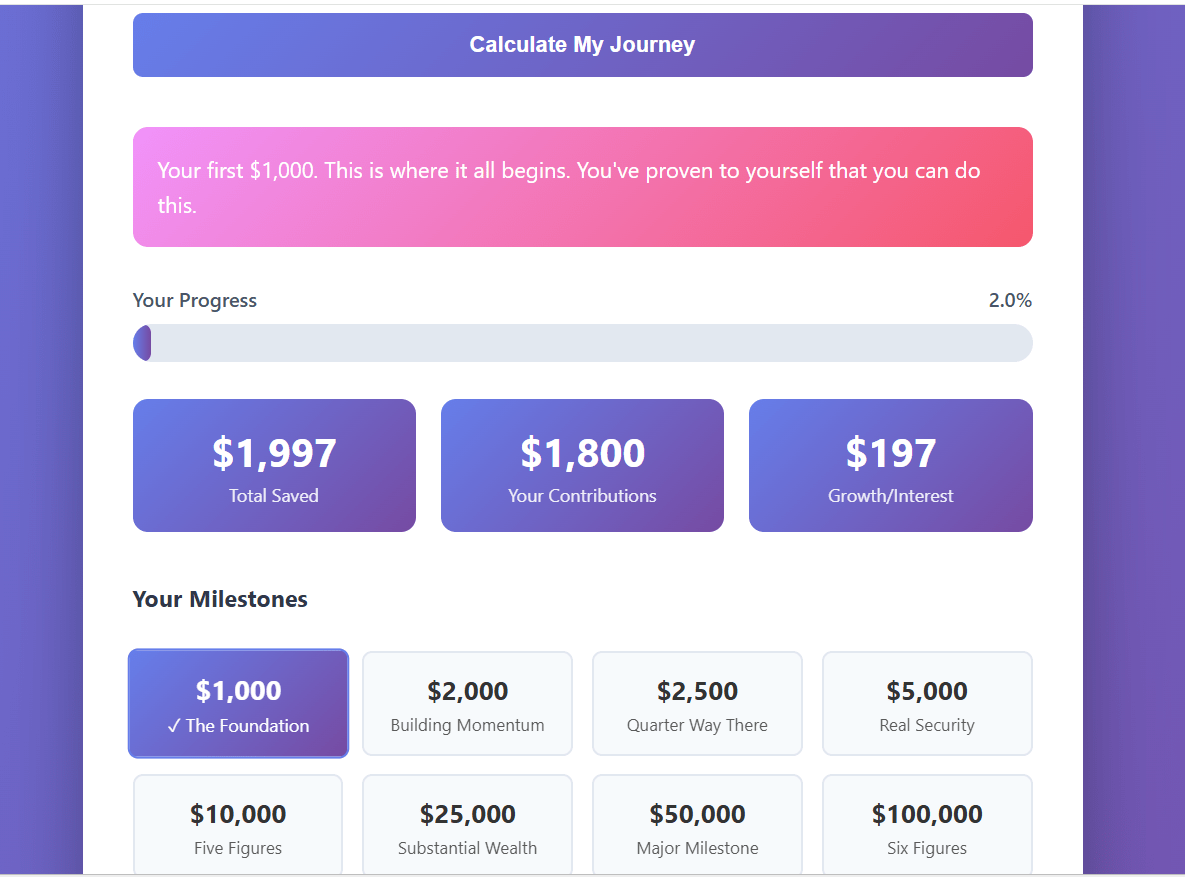
Enter where you’re actually starting from. Negative numbers are accepted. If you’re carrying $4,000 in debt and want to see the realistic path forward, put in -$4,000. The calculator handles it. Most won’t.
Enter what you can realistically contribute each month. This doesn’t have to be $500. It can be $25. It can be $10. The point of this tool is not to make you feel behind, it’s to show you that any amount, contributed consistently, does something. The time value of money is working whether you put in $5 or $500.
Set your expected return rate. Conservative is 5–7%. Historical stock market average is closer to 7–10%. If you’re in a high-yield savings account right now, use 4–5%. Use whatever reflects your actual situation.
Choose your time horizon. Year by year, the calculator maps out where you land.
What you get back: milestone markers at $1,000, $2,000, $5,000, $10,000 and beyond. A visual progress bar. Your projected balance at each year. And encouragement that actually reflects where you’re starting from, not where someone else assumed you’d be.
The Psychology Behind Why Small Contributions Feel Pointless (And Why They’re Not)
This is the part most calculators skip entirely.
There’s a reason $20 a month feels meaningless. It’s not because you’re wrong about math, it’s because human beings are wired to discount the future in favor of the present. We feel the sacrifice of that $20 today far more vividly than we feel the benefit of what it becomes in 15 years. That’s not weakness, that’s behavioral finance. It’s documented, it’s studied, and it affects almost everyone.
The compound effect doesn’t look impressive in year one. It barely looks impressive in year three. But somewhere around year five or six, the line on the chart starts bending upward in a way that stops feeling theoretical and starts feeling real.
I know this because I’ve lived it. I didn’t go from $150 to a five-figure portfolio overnight. I went from $150 to $500, from $500 to $1,000, from $1,000 to watching it grow in ways that still catch me off guard sometimes. Every single milestone felt impossible before I hit it and obvious after.
What changes is not the math. The math was always going to work. What changes is that you finally believe it.
Starting From Debt Doesn’t Disqualify You
This is important enough to say directly.
A lot of financial content, most of it, honestly, is written for people who are already financially stable and want to further grow their wealth. It’s not written for someone carrying student loans, credit card debt, or a financial history shaped by poverty or hardship.
If that’s you, this calculator is specifically for you.
Starting from a negative number doesn’t mean you’re behind. It means you’re starting from where you actually are, which is the only place anyone can start. The scarcity mindset that comes from growing up without financial security is real, it shapes how we think about money, risk, and what’s even possible for people like us. But it’s not permanent. It can be unlearned, one milestone at a time.
Put your real number in. See what the path actually looks like. That’s the whole point.
What the Milestones Actually Mean
The calculator tracks these benchmarks deliberately because each one represents a genuine psychological shift, not just a number.
$1,000 — This is the foundation. For a lot of people, this is the first time money has ever felt like a cushion rather than a countdown. It changes how you respond to small emergencies. It changes your nervous system around money.
$5,000 — This is where the habit is confirmed. You’ve proven to yourself that you can build consistently. The behavioral pattern is set.
$10,000 — Charlie Munger wasn’t wrong about the first $100,000. But $10,000 is its own version of that threshold. This is where compounding starts to feel real rather than theoretical. This is where people around you start to notice something is different about how you carry yourself financially.
$25,000 and beyond — From here, the money starts doing a meaningful portion of the work for you. Dividends compound. Returns compound. The gap between what you contribute and what you accumulate widens in your favor.
I celebrated hitting the first five-figure portfolio milestone with my kid in Seattle. It wasn’t about the money in isolation; it was about what it represented. Years of showing up when it didn’t feel like it was working. It always was.
Use the Calculator
It’s free. It always will be.
→ Use the Broke to Building Wealth Calculator Here
Start with your real numbers. Start from where you actually are. Then let the math show you what’s possible.
And if it helps, share it with someone who needs to see that the path forward exists, even when it doesn’t feel like it does.
Want to understand the concepts behind the calculator? Start here:
- Time Value of Money 101
- The Power of Compound Interest
- The Scarcity Effect: How Growing Up With Less Shapes Financial Decisions
- How to Get Out of Poverty — Even If You’re Starting From Zero
This is meant to be a global classroom to teach everyone who has been left out of conversations involving finances. This blog has reached 90+ countries (and counting). If you’re a student, teacher, or lifelong learner from anywhere in the world, I’m honored you’re here. Economics belongs to all of us.
 The Broke College Student
Leave a comment