You already know I talk a lot about the nervous system on this blog. About how the financial decision is never really the first thing that happens, it’s the last thing. Something happens in your body first, and then the decision follows.
But there’s a layer underneath that I haven’t given its own spotlight yet: the specific mental shortcut your brain reaches for when money gets uncertain. Psychologists call these cognitive biases. I call them blind spots, because that’s exactly what they are, patterns you’re running that you can’t fully see from the inside.
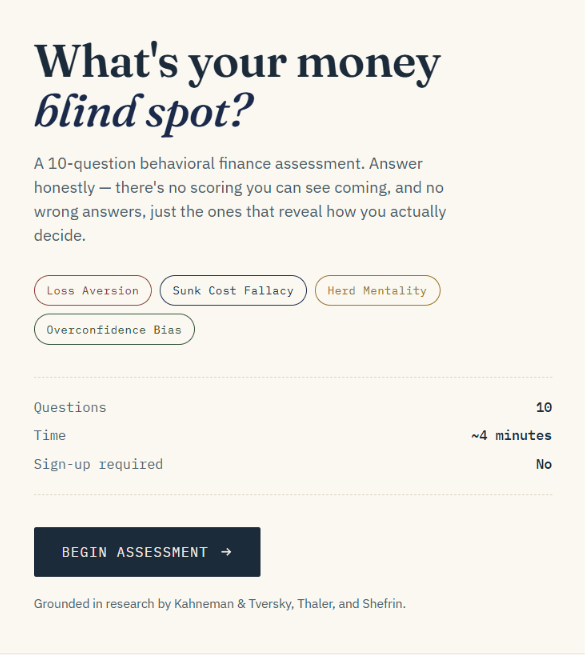
So I built something. A free, ten-question assessment that tells you which one is quietly steering your decisions the most.
The Four Blind Spots
I built this quiz around four biases that show up constantly in how people, including me, handle money. You will probably recognize yourself in more than one, but the quiz is built to find the one running loudest.
Loss Aversion. This is the tendency to feel a loss about twice as intensely as an equal-sized gain. It sounds abstract until you watch it play out, holding a stock that’s down 30 percent “until it comes back,” while selling a winner the second it’s up 10 percent, just to feel like you locked something in.
Sunk Cost Fallacy. This is letting what you’ve already spent, in money, time, or effort, decide what you do next, even though that spent resource is gone either way. It’s the subscription you keep paying for a year in because canceling would mean admitting the year was wasted.
Herd Mentality. This is following the direction of the crowd because it feels safer than standing alone, especially when things are uncertain. It’s buying into whatever your group chat is buying, or panic selling because everyone else is panicking, not because your own numbers changed.
Overconfidence Bias. This is trusting your own read more than the evidence actually supports. Ironically, this one shows up most in people who are genuinely informed, because a little real knowledge can create a false sense of how much uncertainty is actually left.
Why This Matters More Than It Sounds Like It Should
None of these biases are a character flaw. They’re wiring. Your nervous system is doing exactly what it evolved to do, protect you from loss, keep you close to the group, reduce uncertainty as fast as possible. The problem is that markets and money decisions don’t reward that wiring, they punish it.
The first step to working with your wiring instead of against it is knowing which pattern you default to. That’s the whole point of this quiz. Not to diagnose you, just to hand you a mirror.
Take the Quiz
It takes about four minutes. No sign-up, no email required. You’ll get your dominant bias, a full breakdown of where you land on all four, and a link to keep reading on whichever one shows up strongest for you.
Disclaimer: Grounded in behavioral economics research, including the work of Daniel Kahneman, Amos Tversky, Richard Thaler, and Hersh Shefrin.


Leave a comment